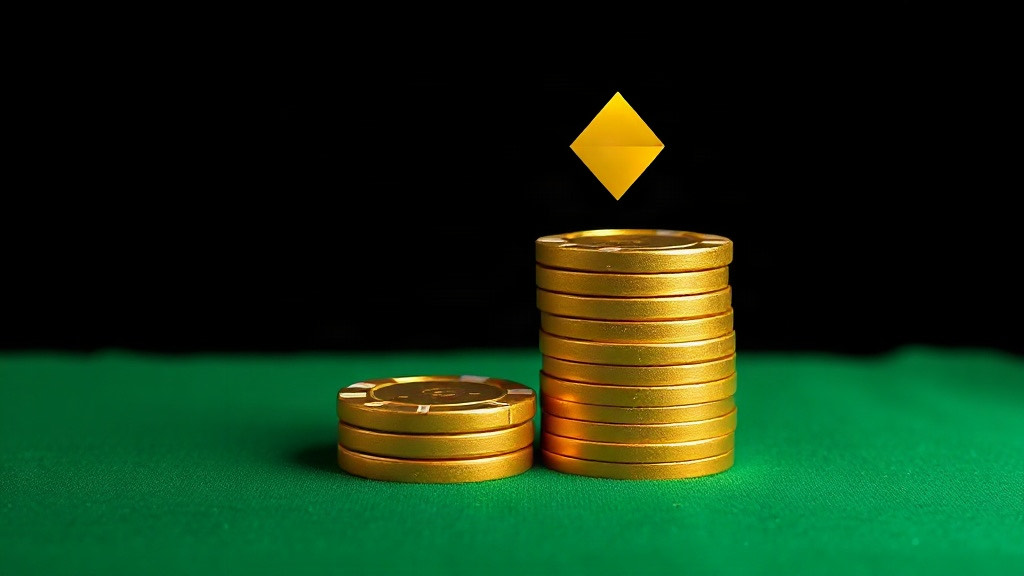
The hand is hard 11 against a dealer 6, one of the best doubling situations in blackjack. The player knows the chart says double. The chips go halfway out instead: a double, but for half the original bet, because the full amount felt like too much after a rough stretch of hands.
It feels like a reasonable compromise between the chart and their nerves. It is actually a third thing: a play that is neither the chart nor the sensible alternative. When doubling is correct, shrinking the double does not scale the strategy down to a more comfortable size. It just quietly gives away part of the value, and past a certain point it can give away so much that plain hitting would have been the better choice.
Many casinos allow players to double for any amount up to the original bet, and the table's rules decide what is permitted. That flexibility is real, and it is worth understanding why, in a standard game, it should never be used.
What a double actually buys
A double down is a trade: you add money to the bet, and in exchange you take exactly one more card and then stand, whether the card helps or not. That one-card restriction is the entire cost of the move, and the extra money is the entire benefit. Our guide to when to double down covers which situations justify the trade.
Notice what the discount does not change: doubling for half the bet still carries the whole restriction. You still take one card and stop. The discount applies only to the benefit side of the exchange, never the cost side, which is the first hint of why the arithmetic comes out so badly.
This is also why the full amount matters so much in the strongest spots. Hard 11 is the flagship: no draw can bust it and the deck's densest value completes it to 21, which is why our piece on doubling hard eleven calls it the one total where the game hands you an unambiguously good situation. Shrinking the double in exactly the spots that justify doubling is backwards.
The arithmetic of the discount
The math is friendlier than it looks, and it needs only three numbers. Call E the value, per unit of bet, of taking exactly one card and stopping: what the hand earns on average per unit wagered if you commit to the one-card deal. Call H the value of hitting normally, keeping the freedom to stop or keep drawing. And call f the fraction of the original bet you add when doubling for less, where a full double means f equals 1.
Three relationships follow. A full double is worth 2E: the original unit plus one more, each earning E. Doubling for a fraction f is worth (1 + f) times E: the original unit plus the smaller added unit, each still earning E. And hitting is worth H, where H is always at least E, because a player who hits can simply stop after one card and reproduce the one-card result exactly, keeping the extra option for free.
Now the chart's logic. The chart says double only when 2E is greater than H. Combine that with H being at least E and something important falls out: 2E greater than H and H at least E together force E to be positive. Every correct doubling situation is a situation where the one-card play earns a positive amount per unit. That is precisely the situation in which adding units helps, so (1 + f) times E grows as f grows and reaches its maximum at the full double. As f shrinks toward zero, the value falls away toward E, which is no better than hitting, and the reason is visible in the formula: you keep paying the one-card restriction in full while collecting the positive per-unit value on fewer and fewer units.
There is even a break-even fraction where doubling for less loses to hitting outright. Hitting is worth H; a partial double is worth (1 + f) times E. The two are equal when f equals H divided by E, minus 1. Below that fraction, the small double is worth less than hitting. In a standard game, that is the complete case against the play: doubling for less is never correct basic strategy or index strategy, and a small enough version of it can be worse than a play, hitting, that the chart already rejected.
 21 TrainerFree on the App Store. Every doubling decision drilled with instant feedback and a clear explanation.
Get the app
21 TrainerFree on the App Store. Every doubling decision drilled with instant feedback and a clear explanation.
Get the app
A worked example with invented numbers
To see the arithmetic move, here is a worked example with round numbers chosen to keep the math easy. They are invented for this illustration, not real values for any specific hand. Suppose the one-card value E is 0.15 per unit and the hitting value H is 0.20 per unit.
Check the doubling question first: twice 0.15 is 0.30, which beats 0.20, so the chart doubles. Then watch what the fraction does:
| Play | Arithmetic | Value per original unit |
|---|---|---|
| Full double (f = 1) | 2 × 0.15 | 0.30 |
| Double for half (f = 0.5) | 1.5 × 0.15 | 0.225 |
| Double for a quarter (f = 0.25) | 1.25 × 0.15 | 0.1875 |
| Hit | H | 0.20 |
The full double earns 0.30. Halving the added money costs a full 0.075 of value, dropping to 0.225, still ahead of hitting. Doubling for a quarter falls to 0.1875, which is below the 0.20 that plain hitting was worth all along. The break-even fraction is H divided by E, minus 1: 0.20 over 0.15 is about 1.33, and minus 1 that leaves about one third of the bet. Add less than about a third in this invented example, and the double for less is a worse play than hitting. If you want a deeper treatment of these comparisons, our introduction to expected value in blackjack builds the concept from the ground up.
Why players do it anyway
The reasons are usually emotional arithmetic rather than card arithmetic. After a losing stretch, the original bet feels heavier than it did an hour ago, and the idea of pushing out a matching stack is uncomfortable. In the moment, half a double reads as splitting the difference between discipline and caution.
But the honest reading is different: the discomfort existed before the hand was dealt, and shrinking a correct double in the middle of a hand does not resolve it; it only gives away value. Practicing in a trainer with virtual chips is one way to make the full double feel unremarkable, so the correct amount goes out without a negotiation.
The pattern extends beyond doubling. Balking at the full amount in a favorable situation, or skipping the double entirely, is a strategy error like any other, and our look at what common mistakes really cost explains why such errors are measured per dollar wagered, not by how one hand turned out.
Soft doubles: the strongest temptation
Soft hands are where the pull toward under-doubling is strongest, because soft doubles feel marginal even to players who make the hard ones without hesitation. Doubling ace-four against a 5 means putting more money behind what is, on its face, a 15. The hand feels too weak to deserve the full treatment, and the partial double becomes the compromise of choice.
The math does not care how the hand feels. The soft doubles on the chart, the soft 13 through 18 family against weak upcards that our guide to soft hands walks through, are exactly the situations where the one-card value is positive, so the same rule applies without modification: when the soft double is correct, the full amount is correct, and a discounted version slides toward plain hitting, and then past it.
Two footnotes for completeness. Tables that restrict doubling to 9, 10 and 11, which our piece on double restrictions covers, remove every soft double, so for those hands the full-versus-partial question never arises. And special formats such as tournaments, where the goal is to finish ahead of other players rather than to maximize expected value, work differently and are outside the scope of this article.
Drill the full doubleColor-coded charts that redraw for your rule set, with instant right or wrong feedback. Free, offline, no account.
Download
Frequently asked questions
Is doubling for less ever the correct play in blackjack?
Not in a standard game. When basic strategy or an index play says double, the most money the rules allow should go out, so doubling for less is never the chart's answer. If doubling for less is better than nothing, a full double is better still. Special formats such as tournaments, where the goal is different, fall outside that rule.
Why is doubling for less worse than a full double?
Doubling means taking exactly one card and adding money. If taking that one card is worth a positive amount per unit bet, then every unit you add earns that same positive amount. A partial double adds fewer units, so it earns less. The chart only recommends doubling in situations where that per-unit value is positive, which is exactly when a bigger double beats a smaller one.
Can doubling for less be worse than just hitting?
Yes. Hitting keeps the option to stop after one card or keep drawing, so hitting is always worth at least as much as taking one card and stopping. Below a break-even fraction of the original bet, the extra money added by a small double earns less than that option is worth, and plain hitting comes out ahead. A too-small double is not a cautious double, it is the wrong play.
Do casinos allow you to double for less than your original bet?
Many commonly do: players are often allowed to double for any amount up to the original bet. But the table's rules decide, and practices vary between casinos and sometimes between tables in the same casino. Whether it is allowed is a separate question from whether it is a good idea, and in a standard game the answer to the second question is no.
How should you practice doubling decisions?
Drill the doubling cells until the full double feels routine rather than reckless. A trainer that gives instant right or wrong feedback with a clear explanation for every decision, like 21 Trainer's free basic strategy drills, builds that habit with no real money involved, so the full double becomes automatic.