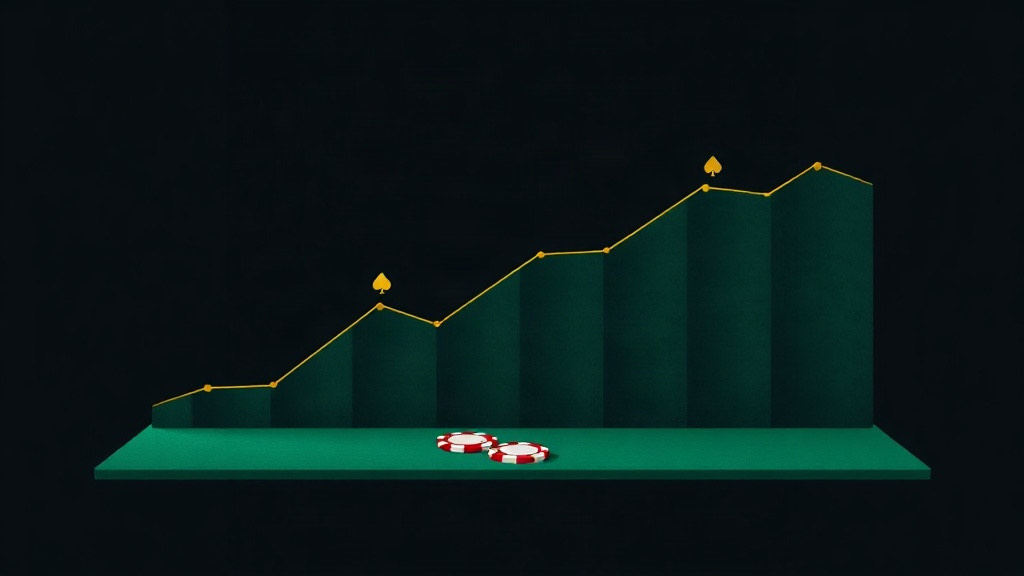
The first week of blackjack practice feels wonderful. Accuracy jumps from wherever you started into the 70s, then the 80s, and the graph looks like it will keep going forever. Then it flattens. You keep drilling, the sessions feel the same, and the number sits in the high 80s or low 90s for weeks.
That flattening is not a sign that you have hit your limit. It is a sign that the practice you are doing has stopped being aimed at anything. Here is why that happens, and what to change.
Why the early gains come so fast
Basic strategy is a finite table of decisions, but the decisions are wildly unequal in how often they appear and how hard they are. A large share of the hands you get dealt are obvious once you have seen them a few times: hard 8 or lower is a hit, hard 17 or higher is a stand, a pair of aces or eights is a split, blackjack pays and moves on.
Learn that layer and your accuracy leaps, because that layer is most of the sample. What is left is the interesting part: stiff totals against small upcards, soft doubles, borderline pairs, and the handful of spots where the correct play changes with the house rules. Those hands are individually rare. Together they are the entire remaining gap.
So the plateau is arithmetic before it is psychology. You solved the common cases, and the common cases were driving the number.
Rehearsing versus confronting
There is a difference between practice that rehearses what you know and practice that confronts what you do not. Rehearsal feels productive. It is fast, you get the green checkmark, the streak counter climbs, and you finish the session pleased. Confrontation feels bad. You get things wrong, the pace drops while you think, and the accuracy number for that session looks worse than last week's.
The second kind is the one that moves you. If a practice session felt smooth from start to finish, it probably taught you nothing new. That is not a reason to punish yourself with impossible drills, but it is a reason to be suspicious of a comfortable routine.
Uniform random practice over-samples the easy stuff
Most trainers, ours included by default, deal hands at random. Random is the right default because it matches the real distribution of hands at a table, and that realism is exactly what makes it a poor teaching tool once you are past the beginner stage.
Think about what a random deal gives you over one hundred hands. A big block of those hands are decisions you already answer without thinking. A handful are the ones you actually miss. If soft 18 against a 9 is your weak spot, a specific player total against a specific upcard is rare enough that you may go several hundred hands between sightings, which means an hour of practice can contain barely any repetitions of the thing you needed to fix.
That ratio is why progress stalls. You are not lazy and you have not plateaued in any deep sense. You are simply getting almost no repetitions of the material that would help.
 21 TrainerFree basic strategy training with a reason for every decision, so a wrong answer teaches instead of just stinging.
Get the app
21 TrainerFree basic strategy training with a reason for every decision, so a wrong answer teaches instead of just stinging.
Get the app
Fix one: aim the practice
The single highest-value change is to stop practicing everything and start practicing the specific hands you miss. That requires knowing which ones those are, which means looking at accuracy by hand class rather than at a session total.
The useful breakdown has two axes: the kind of hand you hold (hard total, soft total, pair) and the dealer's upcard. Weakness almost never spreads evenly across that grid. It clusters, and once you see the grid the cluster is obvious. Common ones we see:
- Soft totals in general, because people treat A,7 as a fixed 18 rather than a hand that changes with the upcard.
- Pairs against a 7 through 9, where splitting feels aggressive and standing feels safe.
- Stiff hands against a dealer 2 or 3, which are the least intuitive stands in the entire chart.
- Anything whose correct play flips with the rules, such as doubling decisions under H17 versus S17.
Once you have the cluster, drill it directly. Deal only those hands, over and over, until the answer arrives before the reasoning does. 21 Trainer's Pro tier does this two ways: heat maps that show accuracy by hand type and dealer upcard, and a Weakness Drill that pulls hands from your worst categories instead of dealing uniformly. Any method works, including writing the ten hands you miss on an index card and testing yourself with a physical deck, as long as the repetitions land where the gap is. Our guide to common practice mistakes covers the rest of the traps.
Fix two: change the conditions, not just the content
Knowing a play in a quiet room and making it correctly at a fast table with people talking are different skills, and the second one has its own plateau. When targeted drilling stops producing gains, change the conditions instead of the content.
| Change | What it tests |
|---|---|
| Increase deal speed | Whether the decision is automatic or still being reasoned out |
| Switch rule sets | Whether you learned strategy or memorized one chart |
| Practice with noise or distraction | Whether accuracy survives divided attention |
| Use a physical deck away from the app | Whether you can play without a prompt to react to |
| Explain each play out loud | Whether you know the reason or just the answer |
Rule switching is the most underrated item on that list. Move from a Vegas Strip preset to a single deck game or a European no hole card game and a handful of your automatic answers become wrong. If that rattles you, you learned a chart rather than the logic behind it, and the fix is to work through why the dealer's soft 17 rule changes anything until the differences make sense. Practice away from the screen tests the same thing from another angle.
Measure the right number
Session chip totals are the worst progress metric available. Short sessions are dominated by variance, so a run of good luck can convince you that a bad week of decisions went well, and a normal losing stretch can convince you that solid play is broken. Neither is information about your skill.
Decision accuracy is the honest number, and even it needs a qualifier: accuracy over what mix of hands? A drill weighted toward easy totals inflates it. Compare like with like, track accuracy by hand class, and treat a stable 96 percent across a realistic mix as far better news than a 99 percent produced by a friendly hand distribution.
One more honest metric: cost. Not every mistake is equal. Missing a double on 11 against a 6 gives up more than misplaying a rare soft hand, so weigh your remaining errors by how expensive and how frequent they are rather than counting them all the same.
When the plateau is fine
Sometimes the flat line is the correct outcome. If your remaining misses are hands that appear once every few hundred deals, and every frequent decision is automatic under speed and distraction, then the accuracy number will barely move no matter what you do, and chasing it is not the best use of your time.
At that point the interesting work is elsewhere: consistency across rule sets, decision speed, or moving on to card counting as a separate skill stack with its own beginner curve. A plateau at a high level with a realistic hand mix is a finished foundation, not a failure. Set a short maintenance routine to keep it, and spend the surplus attention on something new.
And keep the framing straight throughout. Better decisions reduce the house edge; they do not remove it, and no amount of accuracy makes an outcome predictable. What practice buys you is the confidence that when a hand goes badly, it was not your play that made it go that way.
Aim your practicePro adds heat maps by hand type and dealer upcard, plus a Weakness Drill that deals from your worst hands.
Download
Frequently asked questions
Why has my blackjack accuracy stopped improving?
Almost always because your practice stopped matching your gaps. Random hands are dominated by decisions you already own, so most repetitions rehearse what you know instead of confronting what you do not. Once the easy hands are automatic, further progress comes only from deliberately drilling the small set of hands you still get wrong, which random dealing rarely serves up often enough to matter.
What is a good basic strategy accuracy percentage?
Most learners reach the high 80s quickly, then stall. Sustained accuracy in the mid to high 90s over several hundred mixed hands is a strong result, and a stable 99 to 100 percent under speed and distraction is the practical ceiling. The number only means something if the hand mix is realistic, since a drill weighted toward easy totals will inflate it.
How do I find my weak blackjack hands?
Look at accuracy by hand class rather than by session. Break your results down into hard totals, soft totals and pairs, then cross that with the dealer upcard. Weakness clusters: soft 18, pairs against a 9, and stiff hands against a small upcard are common trouble spots. 21 Trainer's Pro heat maps show accuracy by hand type and dealer upcard, and its Weakness Drill deals from your worst hands.
Should I practice blackjack faster or slower to improve?
Both, in that order. Slow practice is where you repair a decision you get wrong, because you have room to think through the reason. Fast practice is where you prove the repair held, since speed strips away the extra second you would otherwise use to reason it out. If accuracy collapses when you speed up, the decision was recalled rather than automatic.
Is it normal to plateau when learning blackjack strategy?
Yes, and sometimes the plateau is the right place to be. Once the frequent decisions are automatic, what remains are genuinely rare hands, so the accuracy number moves slowly by design. The useful question is not whether the number climbed this week but whether the hands you still miss are rare and cheap or common and expensive.