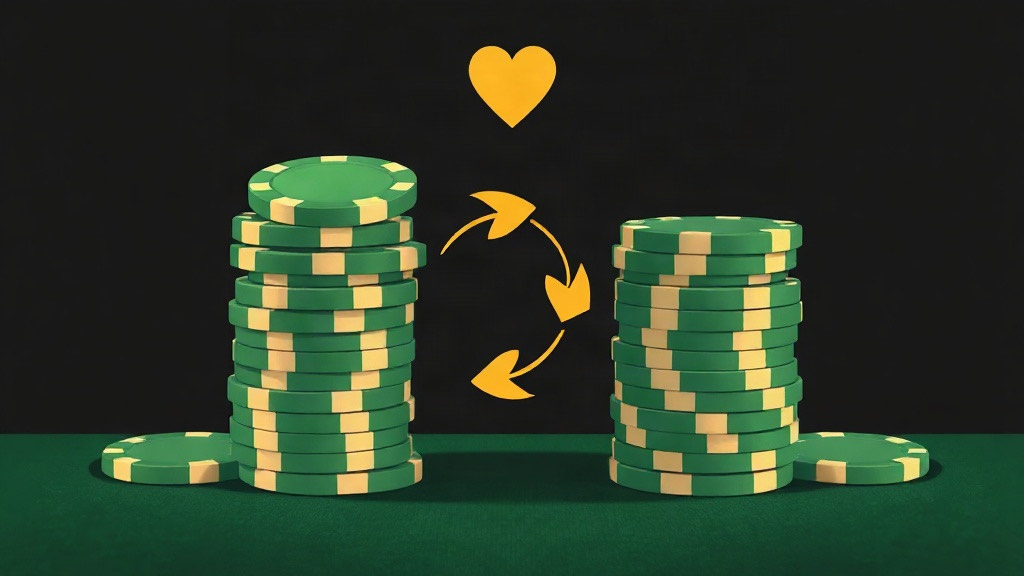
Most blackjack variants offer a trade: something appealing is added, and something quiet is taken away. Spanish 21 removes the 10 spot cards from the deck and hands back liberal rules. Double Exposure shows you both dealer cards and charges you in ties and payouts. Blackjack Switch makes the most generous-sounding offer of all, the right to rearrange your own cards after seeing them, and pays for it with two costly rule changes.
The result is a game that looks like blackjack, is dealt like blackjack, and refuses to be played with a blackjack chart. Understanding what the switch is worth, and what it costs, is a genuinely good exercise in how rule changes move odds, which is the same discipline our house edge explainer teaches for the standard game.
This article covers the mechanics, the two-part price, the switch decision as its own strategy problem, and why the familiar chart has to stay in your pocket.
How the game works
You place two equal bets and receive two hands, played in order against the same dealer upcard. After the deal, and before playing either hand, you may switch the second card dealt to each hand: the card that was dealt second to hand one moves to hand two, and vice versa. The swap is optional, and it is the only moment in any common blackjack variant where a player gets to redesign their cards after seeing them.
From there the hands play normally, with the usual options to hit, stand, double and split, under the table's rules. The commonly analyzed version, the standard Las Vegas rules that Wizard of Odds examines, runs six decks with the dealer hitting soft 17, the rule our S17 versus H17 comparison prices at roughly a fifth of a percent against the player in the standard game.
The price, part one: even money blackjacks
In this game a player blackjack pays even money, not 3:2. Our payout variants guide covers the ladder of natural payouts, and the lesson there applies with full force here: cutting the natural's payout is the single most expensive class of rule change in blackjack. The step from 3:2 down to 6:5 already costs roughly 1.4 percentage points per the commonly published figures, and even money sits well below 6:5 on the same ladder.
The switch privilege is what you receive for that discount, and it is real. Being able to trade a stiff for a strong hand after the deal is worth a great deal, and the game collects part of the payment from your naturals.
The price, part two: the dealer's magic 22
The second charge is stranger. A dealer total of 22 does not bust in Blackjack Switch: it pushes against every player hand still in play. The lone exception is a player blackjack, which still beats a dealer 22. Every other live hand, including hands that drew to a proud 20, gets its money back instead of a win.
One more fine print item belongs here. A two-card 21 created by switching counts as 21, not as a blackjack. So the switch cannot manufacture a natural, which still beats a dealer 22 even at even money; it can only manufacture a strong total.
 21 TrainerNo Switch mode, just the standard-game fundamentals every variant is built on, with the reason behind every play. Free on the App Store.
Get the app
21 TrainerNo Switch mode, just the standard-game fundamentals every variant is built on, with the reason behind every play. Free on the App Store.
Get the app
The switch decision is its own strategy problem
Before any hit or stand, you face a decision no standard chart contains: keep your two hands as dealt, or exchange their second cards. The correct method is to compare the two possible pairs of hands against the dealer's upcard and keep the better pair, weighing both hands together rather than one at a time.
A worked example shows the shape of it. Suppose the dealer shows a middling upcard and you hold a 10 and 5 in one hand, a 6 and 10 in the other. As dealt, that is 10+5 = 15 and 6+10 = 16, two of the worst stiff totals in the game. Switch the second cards, the 5 and the 10, and the hands become 10+10 = 20 and 6+5 = 11: one made hand that only loses to a dealer 21, and one total that cannot bust on the next card. In a standard multi-deck game that stands on soft 17, hard 11 doubles against every upcard but an ace, as our doubling guide explains, and the standard Switch rules allow doubling on any two cards, so the 11 keeps that option here.
That example is unusually clean, and most switch decisions are murkier: trading a good hand and a disaster for two mediums, or giving up a natural (paid only even money here, but a win unless the dealer also has blackjack) to rescue its twin. The general skill is evaluating hand pairs rather than hands, which is why the switch rewards practice and punishes intuition.
Why the standard chart does not transfer
Even with the switch decided perfectly, the hands themselves cannot be played from a standard chart, because the 22 rule rewrites the values underneath it. In ordinary blackjack, a dealer bust is always a win for a live player hand, and that fact is what makes standing on a stiff total against a weak upcard correct: you are waiting for the dealer to break. Here, some of those waits end in pushes instead of wins, so the value of standing on stiff totals shifts, and hit and stand decisions shift with it.
The honest conclusion is short: playing this game well requires a chart computed for this game. The same holds for its cousin. Free Bet Blackjack also funds its headline perk with a dealer 22 push, and its article makes the identical point: a slice of the outcomes that used to be wins now return only your money, so strategy built for ordinary bust rules stops being optimal. The two games charge differently (Free Bet takes its fee through the 22 rule while keeping a 3:2 natural; Switch charges through both the 22 rule and even money naturals), but the distortion to the chart comes from the same source.
What the edge looks like, and how to think about it
Under the standard Las Vegas rules Wizard of Odds analyzes, six decks and a dealer who hits soft 17, optimal play in Blackjack Switch carries a house edge of 0.58 percent. That figure deserves its qualifiers: optimal means the switch decisions and the variant-specific chart both played correctly, and the number belongs to that rule set alone. Rule sheets vary between installations, so a given table's edge is its own question.
For a learner, the useful move is not memorizing a Switch chart but understanding why it differs, because the reasoning is the same arithmetic that explains the standard chart. The standard game is where that reasoning lives: which upcards break, which totals stand, and what each rule change costs. The rule stacking walkthrough shows how small rule effects add up, and our comparison of 3:2 versus 6:5 payouts shows why payout changes dwarf most of them.
One limitation to state plainly: 21 Trainer has no Blackjack Switch mode. What it does have is the standard-game foundation every variant bends, with fully configurable rules and a house edge calculator for pricing rule combinations, all with virtual chips. If the switch idea appeals to you as a puzzle, the underlying skill of judging hands against upcards is exactly what a strategy trainer drills, and it transfers further than any single chart.
Master the base game firstConfigurable rules from one deck to eight, plus a house edge calculator to price them. No account, no ads, works offline.
Download
Frequently asked questions
What is Blackjack Switch?
A blackjack variant in which you make two equal bets, receive two hands, and may swap the second card dealt to each hand. The power is paid for twice over: a player blackjack pays even money instead of 3:2, and a dealer total of 22 pushes against every player hand still in play rather than busting. It is dealt from six or eight decks, and the commonly analyzed version uses six decks with the dealer hitting soft 17.
How does the switch in Blackjack Switch work?
After the deal, you may exchange the second card of one hand for the second card of the other. The decision is its own strategy problem: compare the two possible pairs of hands against the dealer upcard and keep the better pair. A two-card 21 built by switching counts as 21, not as a blackjack, so it does not get a natural's protection: it pushes a dealer 22 instead of beating it.
What happens if the dealer gets 22 in Blackjack Switch?
The dealer does not bust. A total of exactly 22 pushes against every player hand still in play, so hands that would have beaten a broken dealer simply return their money. The one exception is a player blackjack, which still beats a dealer 22. The rule converts a slice of would-be player wins into pushes, and that is part of the price that funds the switch.
Does a natural pay 3:2 in Blackjack Switch?
No. A player blackjack pays even money. That is one of the two charges the variant levies for the switch privilege, and it is a steep discount: per the commonly published figures, cutting a natural's payout from 3:2 is one of the most expensive rule changes in blackjack, which our payout variants guide walks through in detail.
Can you use normal basic strategy in Blackjack Switch?
Not unchanged. The dealer 22 push rule changes the value of standing on stiff totals, because some of the dealer breaks you were waiting for now end in pushes instead of wins. Several hit and stand decisions shift as a result, and the switch itself is a decision standard charts do not contain at all. You need strategy computed for this specific game.