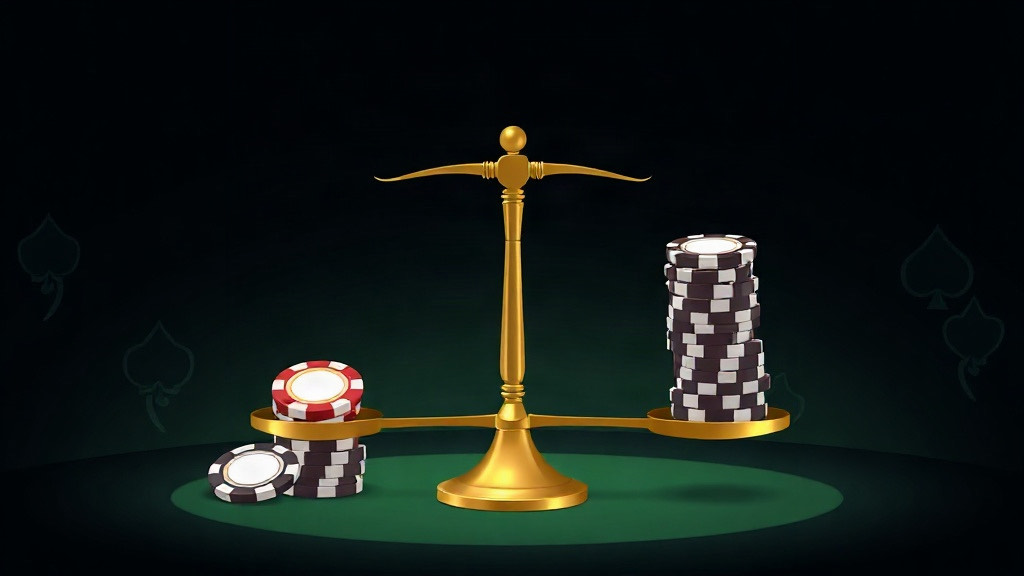
Blackjack's reputation rests on one number: played well, its house edge is roughly half a percent, the lowest of the major casino table games. That number is real, and it is also the most misunderstood figure in gambling. It does not mean you lose fifty cents an hour. It does not mean a good night proves skill or a bad night proves cheating. It is a long-run average with very specific fine print.
This article unpacks the number honestly: what it measures, why blackjack's is so low, which table rules quietly move it, and why an individual session almost never looks anything like it.
What the number actually measures
The house edge is the casino's expected profit as a percentage of each bet, averaged over the long run. A 0.5% edge means that across millions of hands, the house keeps about fifty cents of every hundred dollars wagered. Flip it around and it is the price of the game: blackjack played perfectly costs about half a unit per hundred wagered, in expectation.
Two clarifications keep the number honest. First, it is measured against the amount wagered, not your buy-in; playing a hundred hands at ten dollars each is a thousand dollars of action. Second, it is an expectation, the center of a very wide distribution. The edge says nothing about tonight; it describes the average of an enormous number of tonights.
Why blackjack's edge is so low
Most casino games give you no meaningful decisions; the edge is baked into the payout table and nothing you do moves it. Blackjack is different in two ways. Your choices matter: every hit, stand, double and split changes your expected result, and basic strategy is precisely the set of choices that minimizes the house's take. And the game pays a premium on its best moment: a natural blackjack pays 3:2, a structural gift to the player that the math of the low edge depends on.
That is also why the low edge is conditional. It belongs to a player using correct strategy at a table with decent rules. Play by feel and the gap widens by whole percentage points; sit at a table with hostile rules and the gap widens before you make a single decision.
The rules move the number
Two tables in the same casino can carry meaningfully different edges. Per the commonly published tables (Wizard of Odds maintains the standard references), the rule effects worth knowing are approximately (an edge calculator stacks them for a specific table):
| Rule | Effect on house edge |
|---|---|
| Blackjack pays 6:5 instead of 3:2 | About +1.4 points, the worst common rule |
| Dealer hits soft 17 (H17) | About +0.2 points |
| European no hole card (ENHC) | About +0.11 points |
| Eight decks instead of one | Roughly +0.5 points across the range |
| Double after split allowed (DAS) | About -0.14 points (helps you) |
| Late surrender offered | About -0.08 points (helps you) |
The first row deserves its own sentence: a 6:5 payout costs more than the entire edge of a good 3:2 game, several times over. It is the one rule always printed on the felt, and reading it is the highest-value ten seconds in table selection. The rest stack additively to a good approximation, which is why the same basic strategy player might face 0.3% at one table and well over 2% at another without noticing anything but the decor.
 21 TrainerSee rules stack in the built-in house edge calculator, and drill the strategy that gets you to the low number. Free on iPhone and Android.
Get the app
21 TrainerSee rules stack in the built-in house edge calculator, and drill the strategy that gets you to the low number. Free on iPhone and Android.
Get the app
What mistakes cost
The advertised half percent assumes perfect play, and imperfect play is where the house makes its real money at blackjack. Casual players who stand on 16 against a 10, skip correct doubles, take insurance, or never surrender give back whole percentage points; commonly published estimates put the typical casual player's giveaway at one to two extra points. Each individual mistake looks tiny, a few cents of expectation on a ten dollar bet, and they compound over hundreds of hands into the difference between the cheapest game in the house and an average one.
The practical conclusion runs through drilling, not willpower: mistakes cluster in a predictable handful of hands, and targeted practice on exactly those hands is what closes the gap. That loop is what a real trainer app is for.
Variance: why tonight never looks like the math
Here is the fine print that matters most. A half-percent edge on a ten dollar hand is five cents of expectation, while the standard swing of that single hand is about eleven dollars. The noise is more than two hundred times the signal. Over a few hours of play, the noise barely cancels: winning and losing sessions of many bets in either direction are both completely routine for a perfect player.
This cuts both ways, and both directions mislead. A losing week does not mean you played badly, and a winning week does not mean your system works; at session scale, results are almost pure variance. The edge is only visible from very far away, across thousands of hands. Respecting that is most of what separates informed players from superstitious ones, and it is exactly why chasing losses fails: the math does not remember what you are owed.
The only real ways the number moves
Everything that genuinely changes blackjack's price sits in three places: the rules of the table you choose, the accuracy of your strategy, and, for the few who pursue it seriously, card counting, which under favorable conditions can push expectation slightly past even. Betting systems are conspicuously absent from the list: raising and lowering bets on streaks rearranges variance and moves the edge not at all.
That short list is good news in one specific sense. The house edge is not a mystery or a rigged secret; it is a published, computable number that responds to exactly two things you control. Learn the strategy, read the felt, and you are playing the cheapest widely available game in the casino, eyes open about what half a percent does and does not promise.
Frequently asked questions
What is the house edge in blackjack?
The house edge is the casino's average profit as a percentage of each bet, measured over the long run. With perfect basic strategy under liberal multi-deck rules it is roughly half a percent, meaning about fifty cents of expected cost per hundred dollars wagered. It is a long-run average, not a prediction for any single session, which variance dominates.
Why does a 6:5 blackjack payout matter so much?
Because blackjacks are your best-paid moment, and 6:5 shrinks them. Getting paid 6:5 instead of 3:2 on a natural raises the house edge by roughly 1.4 percentage points per the commonly published tables, which is several times the entire edge of a good 3:2 game. Checking the payout line printed on the felt is the single most valuable rule check a player can make.
Does dealer hitting soft 17 change the odds?
Yes. A table where the dealer hits soft 17 (H17) carries a house edge roughly 0.2 percentage points higher than an otherwise identical stand-on-soft-17 (S17) table, per the commonly published figures. It also changes a handful of correct basic strategy plays, which is why good charts and trainers redraw for the rule.
Can you overcome the house edge in blackjack?
Basic strategy cannot; it minimizes the edge to roughly half a percent but the house keeps it. Card counting can produce a small player edge under favorable rules, commonly estimated at up to about one and a half percent, but it is a demanding skill with heavy swings, and casinos may refuse service to suspected counters. No betting pattern or streak system changes the math at all.
If the edge is only half a percent, why did I lose so much?
Variance. The half-percent edge is an average over enormous numbers of hands; a few hours of play is a tiny sample where swings of many bets in either direction are routine. Short sessions are ruled by luck, and the edge only becomes visible across thousands of hands. That is also why a winning night is not evidence that a system works.