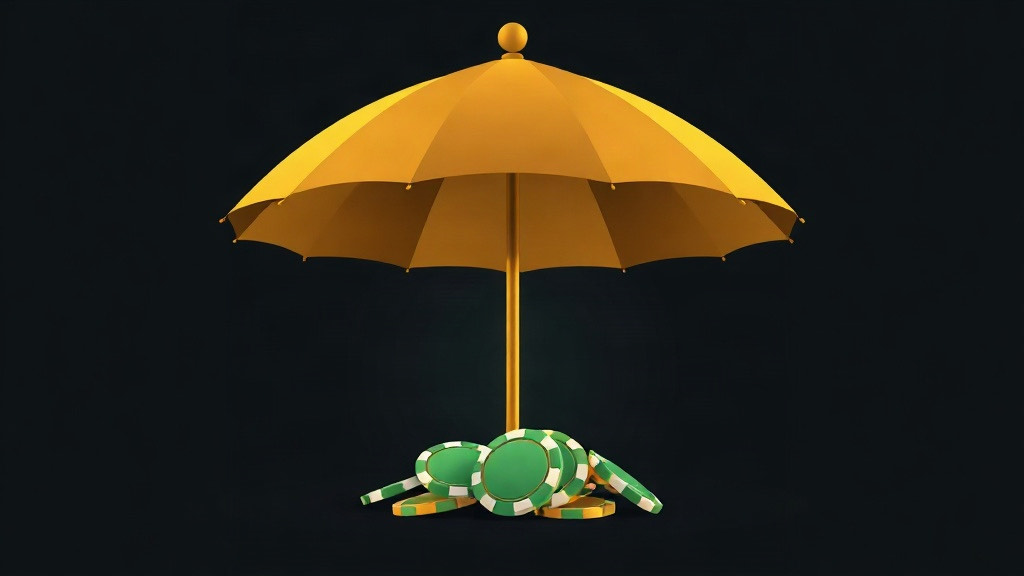
The dealer turns up an ace, raps the table, and asks if anyone wants insurance. It is the most persuasive moment in blackjack. The word promises safety, the offer arrives exactly when you feel exposed, and half the table reaches for chips. Basic strategy declines every single time, and it is not being stubborn. Insurance is one of the worst bets on the felt, and the arithmetic that proves it fits in a paragraph.
What the bet actually is
When the dealer shows an ace, you may place a separate wager, up to half your original bet, that the hole card is a ten-value card and the dealer has blackjack. It pays 2:1. If the dealer does not have blackjack, the insurance bet loses and your original hand plays on normally.
Notice what that description does not contain: your cards. Insurance is settled entirely on the dealer's hole card. It pays identically whether you are holding a 20 or a 12, which is the first clue that the name is marketing rather than mechanics. You are not protecting anything. You are making a brand new bet on one specific card, at a price the house sets.
The arithmetic, in one paragraph
A 2:1 payout is fair only if the event happens one time in three. So insurance breaks even when the hole card is a ten-value card at least 33.3 percent of the time.
Now count the deck. Sixteen of the fifty-two cards are ten-value: the tens, jacks, queens and kings. That is 30.8 percent, and the dealer's exposed ace does not change the ten density of what remains in any helpful direction. So the bet you are being offered wins a bit under 31 percent of the time and pays as though it wins 33.3 percent of the time. That gap is the house's cut, and commonly published figures put the resulting edge on the insurance bet in the neighborhood of 7 percent, more than ten times the house edge of the well-played game you are sitting at.
Read that comparison twice, because it is the whole argument. A player who has carefully learned basic strategy to shave the house edge to roughly half a percent can hand back many hands' worth of that work in a single insurance bet made out of nerves.
 21 TrainerDrill the insurance decision, and every other one, with instant feedback and the reason. Free on iPhone and Android.
Get the app
21 TrainerDrill the insurance decision, and every other one, with instant feedback and the reason. Free on iPhone and Android.
Get the app
Even money is the same bet in a costume
There is a special version of the offer that fools even experienced players. You hold a blackjack, the dealer shows an ace, and you are offered "even money": take one unit right now, guaranteed, instead of risking a push against a dealer blackjack.
It sounds like a different transaction. It is the identical bet, settled early. If you insure your blackjack for the maximum, the two outcomes reconcile to exactly one unit either way, which is why the casino simplifies the ceremony by just handing you the unit. And that is the tell: you are being paid one unit for a hand that, played out, is worth slightly more than one unit on average, because the dealer usually does not have blackjack and your 3:2 payout usually arrives intact.
What you are buying is certainty, and certainty is the thing casinos sell at the highest markup. The instinct behind it, protecting a rare good hand, is precisely the same instinct that our article on variance examines: the discomfort of a swing pushing a player toward a decision that costs money to feel better.
Why the offer feels so different from the math
Three things make insurance persuasive. The name is the first: nobody would take a bet called "the hole card side wager", but everybody understands insurance as a prudent thing responsible adults buy. The second is timing. The offer arrives at the one moment the dealer looks strongest, when your own hand feels precarious, and a small bet that pays 2:1 reads as a hedge rather than an expense.
The third is memory bias. The insurance bets that stick in your mind are the ones that hit, because a dealer blackjack is dramatic and you were the one clever person at the table who saw it coming. The seventy percent of the time the bet quietly loses leaves no such memory. This is exactly the pattern our guide to blackjack odds and myths catalogs elsewhere: vivid outcomes overwriting the boring average that actually determines results.
The one real exception
Basic strategy refuses insurance categorically because it assumes an average shoe. Card counters do not have to assume: they know when the remaining cards are unusually rich in tens, and ten density is exactly what insurance is priced against.
Push the ten concentration high enough and the bet crosses from bad to good. In Hi-Lo, that crossing point is a true count of about +3, per the commonly published indices. That single number is the most valuable entry in Don Schlesinger's Illustrious 18, not because the edge on any one insurance bet is enormous, but because the situation recurs every time an ace shows, which is often.
The exception comes with a hard condition attached. It requires an accurate true count, which requires a maintained running count, which requires the whole skill described in our counting overview. A vague sense that "a lot of small cards have come out" is not a count, and acting on it is just insurance with extra steps. Without the count, the rule stands unchanged.
What to do at the table
Decline. Every time, on every hand, with a 20 or with a 13, holding a blackjack or holding a stiff. The decision does not depend on your cards, the size of your bet, whether you are winning, or how the shoe has been running. It is one of the very few decisions in blackjack with no branches at all, which makes it the easiest expensive mistake to eliminate permanently.
The practical trick is to decide once, away from the table, so the offer never becomes a live question. That is what drilling does: 21 Trainer presents the insurance decision inside normal practice, marks it correct or incorrect immediately, and explains the ten-density reason, until declining is automatic rather than a small act of willpower performed under pressure. Ten minutes of that, as our practice guide lays out, buys a permanent immunity to the most polished sales pitch in the casino.
Frequently asked questions
What is insurance in blackjack?
Insurance is a side bet offered when the dealer shows an ace. You may wager up to half your original bet that the dealer's hole card is a ten-value card, completing a blackjack. It pays 2:1 if you are right and loses if you are wrong. Despite the name, it insures nothing: it is a separate bet on one specific card.
Why is insurance a bad bet?
Because the payout does not match the odds. At 2:1, insurance breaks even only if the hole card is a ten one time in three. In a normal shoe, ten-value cards are a bit under 31 percent of the deck, so the bet comes up short every time you make it. Commonly published figures put the house edge on insurance in the neighborhood of 7 percent, far worse than the game itself.
Should I take even money on my blackjack?
No. Even money is insurance wearing a friendlier name: it is the same bet, settled early, on a blackjack against a dealer ace. Taking it guarantees one unit instead of an average of slightly more than one unit over time. The certainty feels good and costs money, which is why basic strategy declines it exactly as it declines insurance.
Does taking insurance protect a good hand?
No, and this is the most expensive misunderstanding at the table. The insurance bet is settled entirely on the dealer's hole card and pays the same whether you hold 20 or 12. Your own hand has no bearing on whether the bet wins, so insuring a strong hand is simply making a bad side bet at a moment that feels tense.
When is insurance ever worth taking?
Only when you are counting cards and the remaining shoe is unusually rich in tens. In Hi-Lo, insurance turns profitable at a true count of about +3 or higher, per the commonly published indices, which is why it tops Schlesinger's Illustrious 18 list of deviations. Without an accurate count, that exception does not apply and the answer stays no.