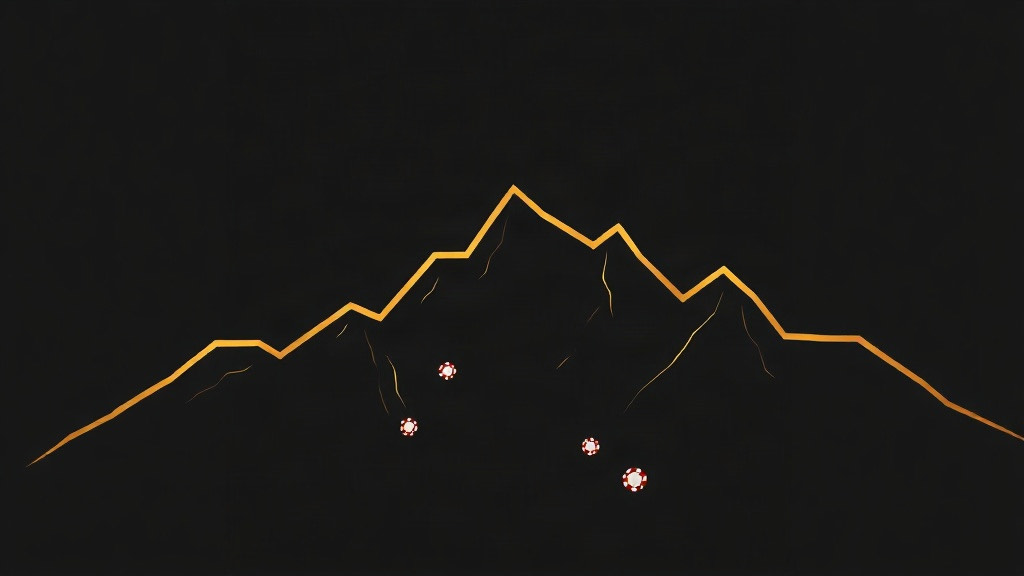
Somewhere tonight, a player who has drilled basic strategy to perfection is watching a sixth consecutive hand lose and concluding that something is wrong: the chart fails, the table is cursed, the shoe is rigged. Nothing is wrong. What they are looking at is variance, the statistical texture of the game, and it is the last subject in blackjack that separates players who understand the math from players who merely memorized it.
This is the honest article this site's whole odds cluster builds toward: what the swings actually are, why streaks are guaranteed rather than ominous, and what, precisely, is worth doing about them. Spoiler on the last one: almost nothing, and that is the skill.
The signal and the noise, sized
Our house edge guide puts the game's expected cost at roughly half a percent of each bet under good rules with perfect play: on a ten-unit hand, a twentieth of a unit of expectation. The swing of that same hand, its standard deviation, is a bit over one full bet, per the commonly published figures, once blackjacks, doubles and splits are averaged in. The noise is more than two hundred times the signal.
That single ratio explains almost everything confusing about blackjack results. Over an evening of a few hundred hands, the accumulated edge amounts to a unit or two of expected loss, while the routine session swing spans dozens of units in either direction. The edge is a whisper under a marching band; you will not hear it tonight, this week, or honestly this month. It is real, it compounds, and across tens of thousands of hands it wins the argument, but no single session ever testifies to it.
Streaks are a promise, not a warning
A blackjack player wins roughly 42 to 43 percent of resolved hands, per the commonly published figures (pushes excluded). Run that number through basic probability and streaks stop looking spooky: losing five straight resolved hands has odds in the neighborhood of one in sixteen, which a few hundred hands of play will produce repeatedly, and stretches of eight or ten consecutive losses are a matter of when, not whether, across a long playing history. Simulated millions of hands show streaks far uglier than anything a weekend player has met, all generated by fair, independent draws.
The gambler's fallacy, dismantled in our odds guide, is the belief that such streaks bend the future: that the shoe owes a correction. It owes nothing. Each round under a shuffle faces the same arithmetic regardless of history, and a streak is not a state of the world, it is a description of the past. The one honest exception in blackjack is composition drift within an unshuffled shoe, and as our counting overview explains, that drift lives in the cards, never in the win-loss ledger.
 21 Trainer ProThe bankroll simulator makes variance visible: perfect play, honest swings, and a discipline grade at the end.
Get the app
21 Trainer ProThe bankroll simulator makes variance visible: perfect play, honest swings, and a discipline grade at the end.
Get the app
What streaks actually damage
Variance cannot touch your expectation; only your response to it can. The damage arrives through three doors, all behavioral. Strategy decay: 16 against a 10 stops getting hit because hitting "keeps busting", and each abandoned chart cell donates real percentage. Bet escalation: chasing losses with raised stakes, the pattern our bankroll guide identifies as the true destroyer of bankrolls, converts a routine downswing into a terminal one. And tilt, the general fog that makes both mistakes feel reasonable. The streak was free; the reaction is what costs.
The defenses are correspondingly unglamorous: units sized so a normal streak is survivable, session limits set while calm, and a strategy drilled deeply enough that it runs on rails when feelings are loud. Decided in advance, none of it requires willpower in the moment, which is precisely the design.
Practicing the storm
Here is the strange advantage a trainer has over a casino: variance can be experienced at no cost. Run enough simulator sessions with virtual chips and every flavor of streak arrives on schedule, the six-loss runs, the cold shoes, the night nothing draws out. The chip totals mean nothing, and that is the point; what the simulator grades is whether your decisions stayed correct through the weather. Strategy adherence under a losing streak is a measurable, trainable stat, and it is the one this entire article has been circling: the mark of an educated player is not avoiding variance, which is impossible, but being boringly unchanged by it. The math does not flinch. With practice, neither do you.
Frequently asked questions
Why am I losing at blackjack even with perfect basic strategy?
Because perfect strategy minimizes the house edge; it does not remove it, and it has no influence at all on short-term luck. The swing of a single hand is enormous compared with its tiny expected cost, so session results are dominated by variance. Losing sessions, and losing weeks, are entirely normal outcomes for flawless play.
How common are long losing streaks in blackjack?
Far more common than intuition expects. A player wins roughly 42 to 43 percent of resolved hands per the commonly published figures, and runs of five or six consecutive losses appear routinely in any long session; much longer streaks are a matter of when, not if, across thousands of hands. Streaks are a property of random sequences, not a signal that something changed.
Does a losing streak mean the next hand is more likely to win?
No. That is the gambler's fallacy. Under a shuffle every round faces the same probabilities regardless of history; the shoe does not track results and owes nothing. The only drift that exists is card-composition drift within an unshuffled shoe, which is what counters track, and it concerns cards, never wins and losses.
How should I handle a losing streak?
By changing nothing strategic: the correct play on the next hand is unaffected by the last ten. The real risks of a streak are behavioral, abandoning the chart, raising bets to chase, or playing tilted, and the defenses are set in advance: consistent unit sizing, session limits decided while calm, and practiced discipline. Streaks end; the damage from chasing them does not undo itself.
Does variance ever help the player?
Constantly: every winning session at a negative-expectation game is variance paying you. The swings run both directions, which is exactly why a hot night is not proof of a system and a cold one is not proof of a curse. Over short spans luck rules; over thousands of hands the edge quietly wins the argument. Knowing which regime you are in is the whole skill.