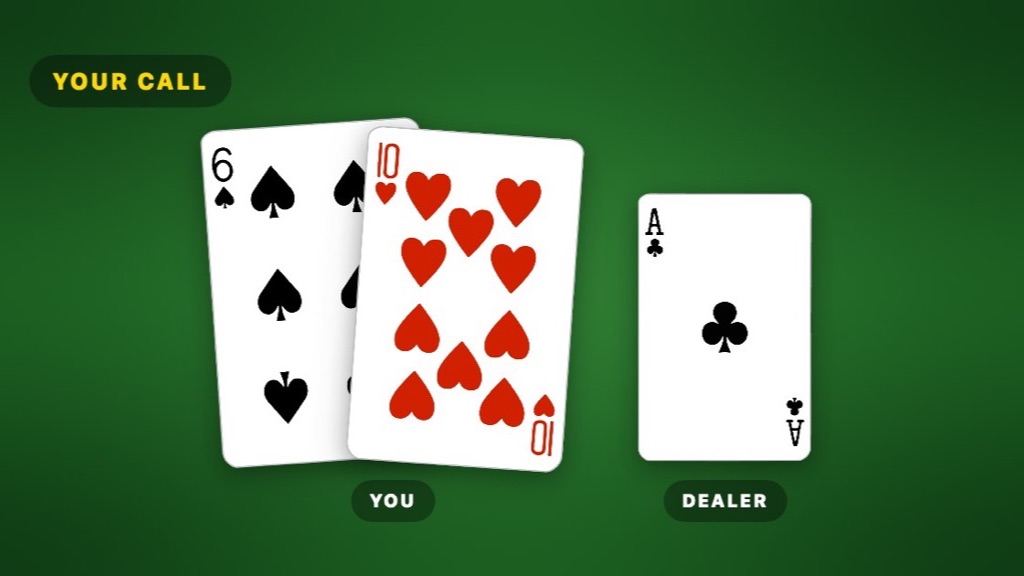
The strongest upcard against the weakest hand. Make your call, then see what the arithmetic leaves you.
Vegas Strip rules: 6 decks, dealer stands on soft 17, double after split, no surrender.
Hit 16 vs Ace. The dealer finishes 17 or better about 83% of the time, so standing gets crushed.
Why the chart says hit against an ace
An ace is the strongest card a dealer can show, and hard 16 is the weakest hand you can hold against it. The question is never how to win this hand, only how to lose the least of it, and under the app's default chart the answer is a hit.
Per the published final total tables for six decks with the dealer standing on soft 17, a dealer showing an ace, already checked for blackjack, busts only 16.7 percent of the time and finishes on 17 or better the other 83.3 percent, the figure the app's tip quotes. A standing 16 wins only on that bust: about 0.167 minus 0.833, roughly 67 cents lost per dollar, the worst standing result anywhere on the chart. Our walk through the dealer ace column carries the whole row of outcomes.
A hit busts on eight of the thirteen ranks, about 62 percent of draws in the infinite deck approximation, and the five small ranks turn the 16 into 17 through 21. Those made hands are what a standing 16 never gets, and across every draw they are worth more than the busts cost, so hitting loses less than standing. The logic is the one behind 16 against a 10, only harsher, because an ace busts even less often than a 10.
Where surrender takes over
Late surrender changes this hand wherever a table offers it, and the comparison is not close: half a bet, 50 cents per dollar, beats both plays by a wide margin. Under the Macau and Atlantic City presets the chart says surrender; the Vegas Strip default has no surrender, so it says hit. The other rules leave it alone. Whether the dealer hits or stands on soft 17, and whether the shoe holds one deck or eight, hard 16 against an ace is a hit in every one of the app's six charts, or a surrender where the table allows it. Our surrender guide covers the few other hands that qualify.
| Table | The play |
|---|---|
| Vegas Strip rules: 6 decks, dealer stands on soft 17, double after split, no surrender. | Hit |
| Macau rules: 6 decks, dealer stands on soft 17, double after split, late surrender. | Surrender if allowed, otherwise hit |
| Vegas Downtown rules: 2 decks, dealer hits soft 17, double after split, no surrender. | Hit |
| European rules: 6 decks, dealer stands on soft 17, no double after split, no surrender. | Hit |
| Atlantic City rules: 8 decks, dealer stands on soft 17, double after split, late surrender. | Surrender if allowed, otherwise hit |
| Single Deck rules: 1 deck, dealer hits soft 17, no double after split, no surrender. | Hit |
| Sydney rules: 6 decks, dealer stands on soft 17, double after split, no surrender. | Hit |
| Monte Carlo rules: 6 decks, dealer stands on soft 17, double after split, no surrender. | Hit |
| Double Deck rules: 2 decks, dealer hits soft 17, double after split, no surrender. | Hit |
 21 TrainerFree on iPhone and Android. Instant right or wrong feedback with a clear explanation on every hand.
Get the app
21 TrainerFree on iPhone and Android. Instant right or wrong feedback with a clear explanation on every hand.
Get the app
What goes wrong at the table
- Standing because the dealer has nothing yet. An ace up has already been checked for blackjack, and what remains still finishes on 17 or better five times in six. Standing wins one hand in six.
- Taking insurance or even money first. Insurance is a side bet on the hole card that basic strategy declines every time, as our insurance guide works through. It has no bearing on what the 16 should do once the peek is over.
- Playing a pair of 8s as a 16. The chart splits 8s against an ace under every preset in the app. Two hands that each start from an 8 lose less than one hand that starts from 16.
- Surrendering out of habit at a table without it, or missing it at one with it. Read the rule card before the first hand, so the decision is already made when the cards land.
Make it automatic
The quiz at the top grades this hand under the app's default chart, Vegas Strip rules, so a hit is the right call there. In the app's practice mode the grade follows the rules you set, and with late surrender switched on the right play becomes surrender and the tip changes with it. Drill it next to its neighbors, 16 against a 9 and 16 against a 10, until the three stop feeling like different decisions: against every strong upcard the hand is a hit without surrender and a surrender with it.
Frequently asked questions
Do you hit or stand on 16 against an ace?
Hit, unless late surrender is offered, and then surrender. A dealer showing an ace, once checked for blackjack, busts only about 16.7 percent of the time per the published six deck tables, so a standing 16 wins one hand in six and loses the rest, roughly 67 cents per dollar. Hitting busts often but loses less overall, because the hands it makes can beat or push a dealer total.
Should you surrender 16 against an ace?
Yes, wherever late surrender is on the table. Half the bet back costs 50 cents per dollar, and both hitting and standing cost more than that against an ace. Among the app's presets that means Macau and Atlantic City; the Vegas Strip default has no surrender, so the chart falls back to a hit, which is how the quiz on this page grades it.
Does the soft 17 rule change 16 against an ace?
No. A dealer who hits soft 17 is a little stronger with an ace up, but hard 16 against it is a hit in all six of the app's charts, one, two and four to eight decks under both soft 17 rules, or a surrender where the table allows it. The soft 17 rule moves other cells in the ace column, the double on hard 11 and the surrender on hard 17 among them, not this one.
Is 16 against an ace worse than 16 against a 10?
Yes, by the standing arithmetic. A dealer 10 busts about 23 percent of the time and an ace only about 16.7 percent, per the published six deck tables, so standing on 16 loses about 54 cents per dollar against the 10 and about 67 against the ace. Both hands hit without surrender and surrender with it; the ace simply leaves the stand even less room to work.
Should you take insurance holding 16 against an ace?
No. Insurance is a separate bet that the hole card is a ten, paying 2 to 1, and basic strategy declines it every time, because ten value cards are fewer than one in three of the deck. Your 16 does not change that arithmetic. Decline it, let the dealer peek, and then play the 16 as the chart says: hit, or surrender where the table offers it.