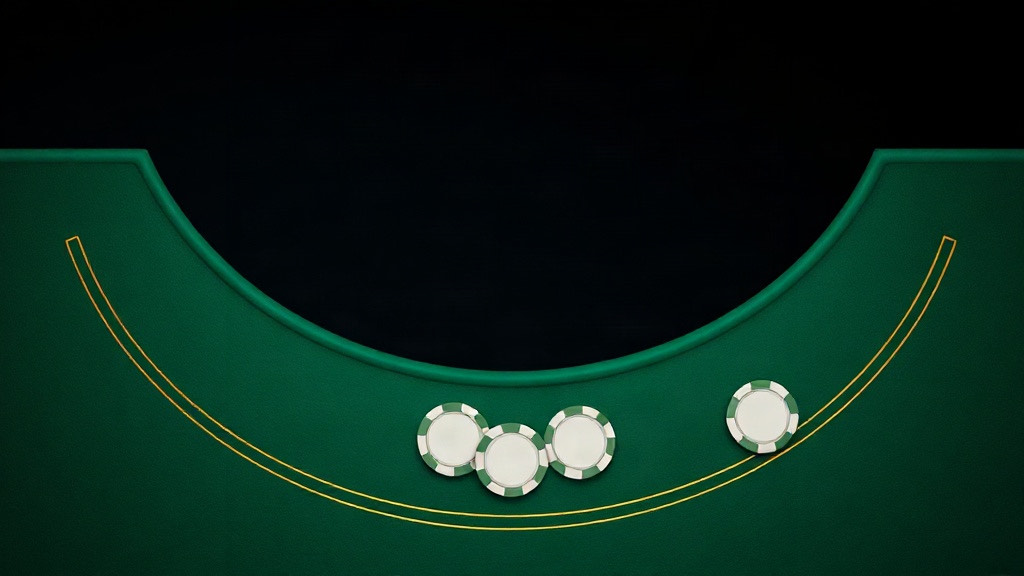
A blackjack table is a document. The words curved across the felt and the small placard at the corner are a rules disclosure, printed there so that anyone can read the terms before they play. Most people never do. They read the table minimum, decide it fits, and sit down.
Reading the rest takes about ten seconds, and the difference between two tables a few feet apart can be larger than the difference between good and sloppy play. This is rules literacy: knowing what the felt says, knowing what it deliberately leaves out, and knowing which line matters most.
The payout line comes first
Somewhere on the felt, usually in the arc above the betting circles, is the payout for a natural blackjack. It reads either "Blackjack Pays 3 to 2" or "Blackjack Pays 6 to 5".
That single line is the most expensive variable on the table. Per the commonly published figures, moving from 3:2 to 6:5 raises the house edge by roughly 1.4 percentage points. To put that in scale: with perfect basic strategy under liberal multi-deck rules, the house edge is roughly 0.5 percent. A 6:5 payout adds more than that entire figure back on top, and nothing you do with your cards recovers it. Our article on 3:2 versus 6:5 works through why the gap is so large.
Read that line before anything else. If it says 6 to 5, you have learned the most important fact about the table, and every other rule on it is a rounding error by comparison.
The soft 17 rule
The second line to find is the dealer's rule on soft 17, printed as either "Dealer Must Hit Soft 17" or "Dealer Must Stand On All 17s". These are abbreviated H17 and S17, and the wording is standardized enough that you will recognize it quickly once you know to look.
The rule governs what the dealer does with a hand like ace and six. Under S17 they stop. Under H17 they take a card, which gives them a chance to improve on a mediocre total. Per the commonly published tables, H17 costs the player about 0.22 percent compared with S17.
It also changes several of your correct plays, mostly around doubling soft hands and a few surrender decisions, which is the practical reason to notice it rather than shrug at a fifth of a percent. Our comparison of S17 and H17 covers which cells of the chart move.
Limits, insurance, and the geometry
The placard at the corner of the table carries the minimum and maximum bet. Those numbers are about bankroll rather than odds, but they are what determine whether a table is appropriate for you at all. The standard guidance in bankroll management is to size the table to your bankroll rather than the other way around.
The felt also prints "Insurance Pays 2 to 1" along a line in front of the dealer. That is a statement of the payout, not a recommendation, and basic strategy declines insurance every time regardless of your hand. The line is there because insurance is a formal side bet with its own betting area. The reasoning behind always saying no is in our piece on insurance.
Beyond the printing, the physical layout tells you a little too. A table with seven betting circles is a shoe game. A shoe box on the dealer's left and a discard tray on the right is the classic arrangement. A machine built into the table is a shuffler of some kind, which matters more than it looks.
 21 TrainerSet the exact rules you are studying: decks, H17 or S17, DAS, surrender, 3:2 or 6:5. Charts redraw to match. Free on the App Store.
Get the app
21 TrainerSet the exact rules you are studying: decks, H17 or S17, DAS, surrender, 3:2 or 6:5. Charts redraw to match. Free on the App Store.
Get the app
What the felt does not tell you
Here is the part that catches people out. The rules with the biggest effect on your strategy chart are often not printed anywhere. A quick comparison:
| Printed on the felt or placard | You have to watch or ask |
|---|---|
| Blackjack payout (3:2 or 6:5) | Number of decks in the shoe |
| Dealer hits or stands on soft 17 | Double after split allowed |
| Table minimum and maximum | Surrender offered, and early or late |
| Insurance pays 2 to 1 | Split and resplit limits, including aces |
| Betting circle layout | Whether the shuffler is a CSM or an ASM |
Deck count you can usually judge by looking at the shoe, or simply ask. Doubling after a split gains the player about 0.14 percent per the published tables, and late surrender about 0.08 percent, so both are worth knowing even though neither is normally printed. Resplitting aces almost never appears on the felt and is a genuine improvement where it exists.
The shuffler distinction is the one most people miss. A continuous shuffling machine returns discards to the shoe continuously, which keeps the deck composition near neutral and makes counting ineffective. An automatic shuffler prepares a separate shoe between rounds and does not prevent counting by itself. Both are boxes on the table and they look similar. The tell is behavioral: with a CSM, the dealer feeds discards back into the machine after every round, and there is no discard tray filling up.
Asking the dealer is normal and expected. Dealers answer rules questions constantly, and "can I double after splitting?" is not an unusual thing to say. Read the printed material first so your questions cover only what is genuinely absent.
Rules travel, and they change the chart
None of this is fixed geography. Rule sets vary between casinos, between pits inside one casino, and between countries: European tables commonly deal without a hole card, Australian and Macau games have their own conventions, and single deck games exist alongside eight deck shoes on the same floor. Our survey of how blackjack rules travel lays out the regional patterns.
The reason to care as a learner is that basic strategy is not one chart. It is a family of charts, and several cells move with the rules you just read off the felt. Practicing one chart and assuming it covers everything is how people end up confidently making the wrong play at a table that is a shade different from the one they trained on.
This is the right way to use rule settings in a trainer. 21 Trainer has 9 casino presets (Vegas Strip, Vegas Downtown, Atlantic City, Macau, Monte Carlo, Sydney, European ENHC, Single Deck, Double Deck) and full rule customization for decks, H17 or S17, double after split, early or late surrender, split limits, payout and shuffler type, and the color-coded charts redraw automatically for whatever you set. Its house edge calculator will also show you how a rule stack adds up, which is the same arithmetic our rule calculator article walks through by hand.
The ten-second version
Before sitting at any table, in order:
- Read the payout line. 3:2 or 6:5. Nothing else on the table is worth this much.
- Read the soft 17 line. H17 or S17, and remember it changes a few of your plays.
- Check the placard for the minimum and maximum.
- Glance at the shoe for deck count and at the machine, if there is one, for how discards are handled.
- Ask the dealer about double after split, surrender, and resplit rules.
To be clear about the framing: this is rules literacy, not an invitation. Knowing how to read a table is a piece of understanding the game, in the same way that knowing how a mortgage amortizes is a piece of understanding a loan. You can practice every one of these rule sets in the app with virtual chips and find out exactly how the chart shifts, which is the version of this exercise we would actually recommend.
Frequently asked questions
What do the words printed on a blackjack table mean?
The felt is a rules disclosure. It normally prints the blackjack payout, either Blackjack Pays 3 to 2 or Blackjack Pays 6 to 5, and the dealer's soft 17 rule, usually written as Dealer Must Hit Soft 17 or Dealer Must Stand On All 17s. It also marks the insurance line and the betting circles. A placard at the corner of the table carries the minimum and maximum bet.
Is 6 to 5 blackjack worse than 3 to 2?
Substantially, and it is the single most expensive common rule difference. Per the commonly published figures, a 6 to 5 payout raises the house edge by roughly 1.4 percentage points, which is larger than the entire edge of a good 3 to 2 game played with correct basic strategy. No other rule on the felt moves the number that far, which is why the payout line is the first thing to read.
How can you tell if the dealer hits soft 17?
It is printed on the felt. Dealer Must Hit Soft 17 means the dealer takes a card on ace-six, often abbreviated H17. Dealer Must Stand On All 17s means they do not, abbreviated S17. Per the commonly published tables, H17 costs the player about 0.22 percent compared with S17. If the wording is worn or unclear, the dealer will tell you.
What rules does a blackjack table not print on the felt?
Quite a few of the ones that matter. The felt rarely tells you the number of decks, whether doubling after a split is allowed, whether surrender is offered, how many times you may split or resplit, or whether the shuffler in use is a continuous shuffling machine or an automatic shuffler. You learn those by watching a few rounds or by asking the dealer, who will answer plainly.
Should you ask the dealer about the rules?
Yes, and it is completely normal. Dealers answer rules questions all the time, and asking whether you can double after a split or whether surrender is available takes a few seconds. Rules are not secret information. The one thing worth doing first is reading the felt and the placard yourself, so the questions you ask are only about what is genuinely not printed.