You split a pair of 8s, the dealer places a card on the first hand, and it is another 8. Now what? Depending on the table, you either split again and put out a third bet, or you play a hard 16 you specifically tried to avoid.
That fork is governed by the table's resplit rule, one of the least discussed and most commonly misread items on a rule card. It rarely changes what you should do with a hand, but it changes what the hand is worth, and it changes how much money one starting bet can turn into.
What a resplit actually is
Splitting separates a starting pair into two hands, each receiving new cards and each carrying its own bet equal to your original wager. A resplit is doing that again, on a hand produced by the first split, when the new card happens to make another pair.
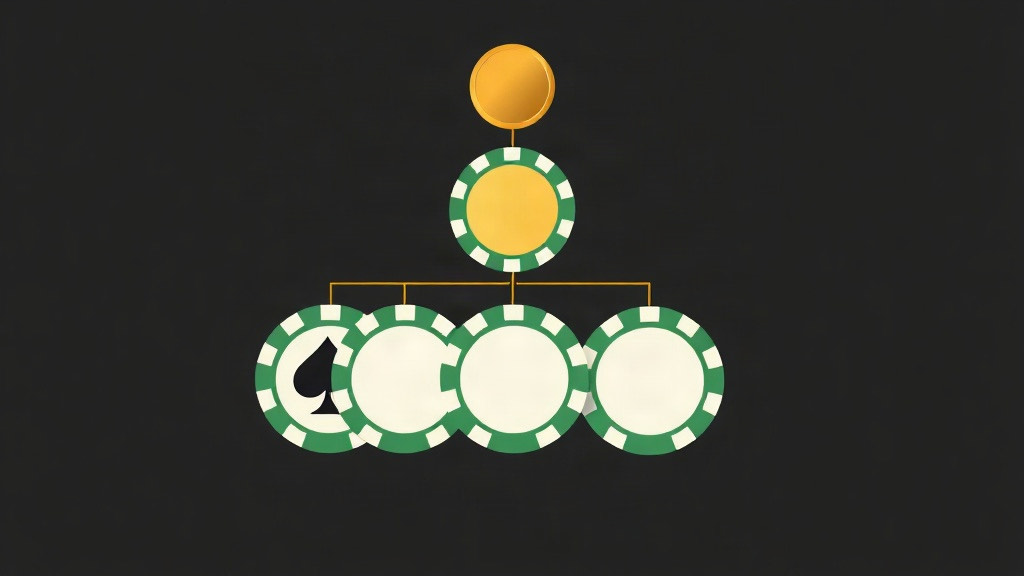
Each split adds one hand and one bet. So the counting goes: no splits is one hand and one bet, one split is two hands and two bets, two splits is three hands and three bets, three splits is four hands and four bets. When a casino advertises "split to four hands," it means up to three splits total, which is the standard people most often miscount.
Resplitting is only possible when the card you receive matches. A resplit rule is permission, not an obligation, and it only comes into play in the fairly rare situation where a pair reproduces itself.
The common house standards
Split to four hands is the most widespread rule in American shoe games, and it is the baseline most published strategy charts assume. Below that, some tables cap at three hands (two splits), and a small number of games allow unlimited resplitting of non-ace pairs, which sounds generous and is worth almost nothing because the fifth hand almost never arrives.
Aces are handled separately at nearly every table. The near universal rule is that each split ace receives exactly one card and the hand ends there: no hitting, no doubling, no drawing your way out. Many tables extend that restriction by forbidding resplit of aces entirely, so a third ace simply sits as a soft 12 with a single card on it. Some games do permit resplitting aces, and where they do it is a genuine player benefit, which our article on the resplit aces rule covers in full.
The asymmetry is not an accident. Split aces are the strongest split in the game, which is exactly why aces and 8s always split, and casinos restrict the most valuable options first.
 21 TrainerSet split limits, DAS and surrender, and the strategy chart redraws for your table. Free on the App Store.
Get the app
21 TrainerSet split limits, DAS and surrender, and the strategy chart redraws for your table. Free on the App Store.
Get the app
What the rules are worth
These are small effects, and it is worth saying so before the numbers appear, because rule effects are easy to over-read. Per the commonly published rule effect tables, the figures look roughly like this.
| Rule variant | Approximate effect on the player |
|---|---|
| Resplit to four hands (the usual baseline) | Reference point |
| No resplitting at all | Costs about 0.06 percent |
| Resplit to three hands only | Costs a small fraction of that 0.06 percent, since the fourth hand adds only a hundredth or two |
| Resplit aces allowed | Gains about 0.08 percent |
Two things stand out. The first is that resplitting aces is worth more on its own than all non-ace resplitting combined, which tells you how strong a split ace is even under the one-card restriction. The second is that most of the value in ordinary resplitting sits in the first resplit, the one that takes you from two hands to three. The fourth hand is close to a rounding error, because reaching it requires a pair to reproduce itself twice in one round.
For context, compare these with the rules that actually move the needle. A 6:5 blackjack payout raises the house edge by roughly 1.4 percentage points, more than twenty times the entire resplit question, as our comparison of 3:2 versus 6:5 lays out. A dealer who hits soft 17 costs about 0.22 percent. Resplit limits belong in the same tier as the fine print, worth knowing and never worth choosing a bad table for.
How resplit limits interact with other rules
Split rules do not live alone on a rule card, and two interactions matter.
Double after split. Splitting is worth more when the resulting hands can be doubled, because a large share of the value in splitting low pairs comes from the hands that develop into 9, 10 or 11 against a weak upcard. A table with generous resplitting and no DAS is a worse split environment than a table with tighter resplits and DAS available. DAS is worth roughly 0.14 percent to the player per the commonly published figures, which is more than twice the whole resplit effect.
Your own bankroll at the table. This is the practical constraint people forget. Every split requires another full bet, so a hand split to four hands puts four units at risk from a starting bet of one, and if DAS is available and you double one of those hands, five. A rule you cannot afford to use is not a benefit. If your table minimum sits close to what you brought, a generous split rule is decoration.
This is also why the resplit rule interacts with bet sizing more than with strategy. Nothing about the correct play of a pair changes because you might have to put out a third bet, and deciding to skip a correct split because the hand is getting expensive is precisely the kind of drift that shows up as an accuracy problem, of the sort catalogued in our piece on what common mistakes cost.
How to read a table's split rules
The felt usually states the payout and the soft 17 rule and stays silent about splitting. The rule card, if there is one, is more complete. Otherwise the dealer will answer directly, and the three questions worth asking take about five seconds:
- How many hands can I split to?
- Can I resplit aces?
- Can I double after splitting?
The third one matters most, the second is a nice surprise when the answer is yes, and the first is the one people ask about most and should care about least. If you are surveying tables more broadly, the same short list belongs alongside deck count, payout and soft 17, in the order set out in our guide to reading the felt.
The practical takeaway
Split limits are a real rule with a small effect. Learn what "split to four hands" means so you are not surprised mid hand, know that aces are almost always one card and often cannot be resplit, and understand that the first resplit carries nearly all the value while the fourth hand carries almost none.
Then put the rule where it belongs on your priority list, which is well below the payout, the soft 17 rule, DAS, and your own decision accuracy. A player making correct decisions at a 6:5 table with generous splits is worse off than one making correct decisions at a 3:2 table that caps at three hands, by a wide margin. And no combination of favorable rules turns blackjack into a game the player is favored to win: good rules shrink the house edge, they do not reverse it.
See rules stack upThe house edge calculator shows what split limits, DAS and payout do together. No account, works offline.
Download
Frequently asked questions
How many times can you split in blackjack?
The most common house standard is splitting to a total of four hands, which means up to three splits on one round. Some tables allow only three hands, a few allow unlimited resplitting, and aces are almost always restricted separately. The rule is usually printed on the table felt or the rule card, and it varies enough between casinos that it is worth checking rather than assuming.
What is a resplit in blackjack?
A resplit is splitting again after you have already split once. If you split a pair of 8s and the next card on the first hand is another 8, a table that allows resplitting lets you separate that hand too and place a third bet. Each resplit creates one more hand and requires one more bet equal to your original wager.
How much does it cost if a table does not allow resplitting?
Not much, but it is not zero. Per the commonly published rule effect tables, not allowing any resplitting costs the player roughly 0.06 percent compared with resplitting to four hands. Most of that value sits in the first resplit, the one that takes you to three hands, with the fourth hand adding only a hundredth or two of a percent on top.
Why can you not resplit aces at most tables?
Because split aces are the most valuable split in the game and casinos restrict them deliberately. The near universal rule is one card to each split ace with no further action, and many tables extend that to forbid resplitting a third ace, so it becomes a soft 12 that stands. Where resplitting aces is allowed, it is worth about 0.08 percent to the player per the commonly published tables.
Do you need more bankroll to play at a table that allows four splits?
You need to be able to cover the additional bets, yes. Every split places another wager equal to your original, so a hand split to four with a double on one of them can put five units on the felt from a single starting bet. The rule is a small benefit on average, and it is only a benefit if you can actually take the splits when they appear.