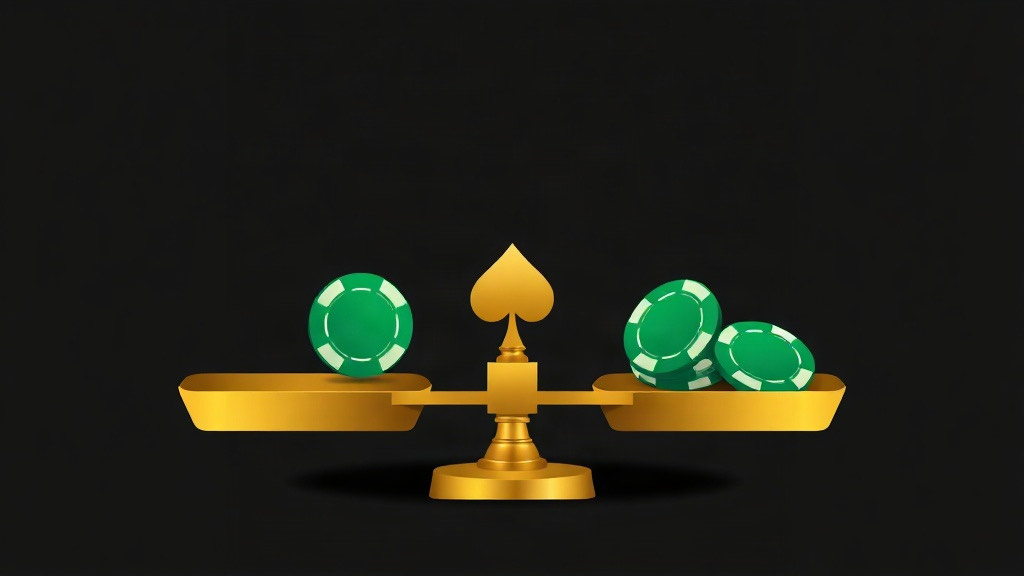
Every explanation of card counting eventually says something like "Hi-Lo is balanced, KO is not," and then moves on. The sentence is true and mostly useless. The balanced versus unbalanced distinction is not a technical footnote to the systems; it is the design decision that determines what you do with the running count every time you act on it: divide it by your estimate of the decks remaining, or use it as it stands. Understanding why takes one line of arithmetic.
Here is the line. Deal out a complete 52 card deck and add every tag as it falls. If the total ends at zero, the count is balanced. If it ends anywhere else, the count is unbalanced, and that deliberate tilt is doing specific work.
The arithmetic of balance
Take Hi-Lo, the system most counters learn first. The plus cards are the 2 through 6: five ranks, four cards each, 20 cards at plus one. The minus cards are the 10, jack, queen, king and ace: five ranks again, 20 cards at minus one. The 7, 8 and 9 count zero. So a full deck counts 20 plus and 20 minus, and a complete pass ends at exactly zero. That is what balanced means, and it has a useful consequence: any drift away from zero measures a genuine shift in what remains.
Now tilt the tags. KO promotes the 7 from zero to plus one, which adds four cards to the plus side: 24 against 20, a net of plus four per deck. Red Seven counts only the two red 7s at plus one: 22 against 20, a net of plus two. Neither pass can finish where it started, so both systems are unbalanced by construction.
| System | Plus cards per deck | Minus cards per deck | Net per deck |
|---|---|---|---|
| Hi-Lo | 20 (2 through 6) | 20 (10 values and aces) | 0 |
| KO | 24 (2 through 7) | 20 | +4 |
| Red Seven | 22 (2 through 6 plus the two red 7s) | 20 | +2 |
The same test sorts the rest of the well known systems. Zen and Omega II, both level two counts, are balanced: their plus tags and minus tags cancel across a deck, exactly as Hi-Lo's do, which their published descriptions state outright. Hi-Opt I and Hi-Opt II are balanced as well, and their article shows the cancellation card by card. Both unbalanced systems in the table get there the same way, by promoting all or part of the 7.
 21 Trainer ProHi-Lo, KO, Omega II and Zen with counting drills at every stage, virtual chips only.
Get the app
21 Trainer ProHi-Lo, KO, Omega II and Zen with counting drills at every stage, virtual chips only.
Get the app
The price of balance: division
Balance buys precision and charges a fee at the table. A balanced running count measures the surplus of high cards left, not how concentrated they are, so the raw number is ambiguous on its own: a running count of plus 6 means a lot when one deck remains and not much when six remain. So balanced counts are converted to a true count by dividing by the estimated decks remaining, which is the concentration measure that betting and playing decisions actually key off.
The division drags two skills with it. You have to estimate the decks remaining, usually by eyeing the discard tray, which is a trained skill of its own and the subject of our deck estimation practice piece. And you have to divide quickly and consistently, including deciding how to handle awkward fractions, the question our article on rounding the true count takes up. None of this is intellectually hard. All of it is extra live arithmetic, running continuously, on top of counting every card and playing your hands.
What imbalance buys: a starting count
The unbalanced design removes the division by building the adjustment into the count itself. Each deck dealt pushes a KO running count up by four on average, so the same surplus of high cards shows up as a bigger number late in the shoe than early, which is the same direction the true count conversion pushes. Choose the right starting value and the drift stands in for the division, approximately: a threshold can be set as one fixed running count value instead of a true count that has to be converted.
The starting values are simple formulas. The standard initial running count from the Knock-Out book is 4 minus 4 times the number of decks: 0 for single deck, minus 4 for double deck, minus 20 for six decks, minus 28 for eight. Decisions then key off fixed running count values, such as the book's key count, which our KO article describes. Red Seven uses minus 2 multiplied by the number of decks, minus 12 for a six deck shoe, and carries a neat self check: counting every card of that shoe down finishes at exactly zero, the property balanced counts have for free. KO's formula does not aim for it: a full KO shoe counted down ends at plus 4. What both systems offer is the same: no tray reading and no division.
The trade, in published numbers
The division is not overhead for nothing. A divided true count adjusts for the decks actually remaining; an unbalanced count's built-in drift only approximates that adjustment, so its estimate is slightly noisier. The noise shows up where fine distinctions matter most, in playing decisions rather than betting, which is why, as our KO article notes, KO players typically carry a shorter, simpler deviation list.
The commonly published comparison table our counting efficiency metrics piece reproduces needs careful reading here, because its figures mostly reflect tag choices and level rather than balance. Playing efficiency, the metric for how well a count guides departures from basic strategy, runs .51 for Hi-Lo and .55 for KO, against .63 for Zen and .67 for Omega II: the unbalanced KO edges out the balanced Hi-Lo, and the level two counts lead both. KO also posts a betting correlation of .98, the highest of the four, so the unbalanced design gives up almost nothing for betting, while the balanced level two counts collect their playing efficiency by charging harder mental work per card. Which trade suits you is the question our choosing a system guide works through, and its verdict is that system choice matters far less than accuracy and speed: an unbalanced count kept flawlessly can beat a balanced count divided badly.
Where to practice either kind
21 Trainer teaches four systems in the Pro upgrade: Hi-Lo, Zen and Omega II on the balanced side, and KO on the unbalanced side. The upgrade includes single card drills, multi-card counting and a true count drill, the last being the specific skill the balanced design demands. The bankroll simulator uses virtual chips, because this is a practice environment, not a betting tool.
The usual caveats belong here. Counting cards with your head is legal in the United States, and electronic devices are a separate matter entirely. Casinos are private businesses that may refuse service to players they suspect of counting, with jurisdictional differences in how far that goes. And no technique, balanced or unbalanced, removes the risk from the game; counting at best yields a small long-run edge with large short-term swings, and losing stretches stay routine even for counters who execute well.
Frequently asked questions
What does balanced mean in card counting?
A count is balanced when its tag values sum to zero across a full 52 card deck. Hi-Lo is the standard example: the 2 through 6 are twenty plus cards at plus one each, the ten values and aces are twenty minus cards, and a complete pass through the deck ends exactly where it started. Any drift from zero then measures a real change in what remains, but the same running count means more when fewer cards are left, so a balanced count is converted to a true count before it is acted on.
Is the KO count balanced or unbalanced?
Unbalanced. KO tags the 2 through 7 as plus one, which puts 24 plus cards against 20 minus cards in every deck, a net of plus four. A full pass therefore climbs instead of returning to zero. The standard initial running count from the Knock-Out book is 4 minus 4 times the number of decks, and that built-in drift is what lets KO be played without any division.
Why do unbalanced counts not need a true count?
Because each deck dealt pushes the running count up by a known average amount, plus four per deck for KO, plus two for Red Seven. Started from an initial running count chosen for the deck number, that drift roughly performs the decks remaining adjustment that balanced counts do by dividing. The raw running count then approximates concentration well enough to act on directly, with no tray reading and no division.
Are balanced counts more accurate than unbalanced ones?
Slightly, when the tags are otherwise similar: dividing by the decks remaining is more precise than an unbalanced count's built-in drift, which only approximates that adjustment, and the difference shows most in playing decisions. The commonly published playing efficiency figures mostly reflect tag choices and level rather than balance: KO at .55 sits a shade above Hi-Lo at .51, while the level two counts, Zen at .63 and Omega II at .67, sit higher still. At the table, execution matters more than either: an unbalanced count kept flawlessly can beat a balanced count divided wrong.
Which counting systems does 21 Trainer teach?
Four systems in the Pro upgrade: Hi-Lo, Zen and Omega II, which are balanced, and KO, which is unbalanced. The upgrade includes single card drills, multi-card counting, a true count drill and index deviation training, and its bankroll simulator uses virtual chips only. The app is a practice environment, not a betting tool, and no system it teaches removes the risk from the game.