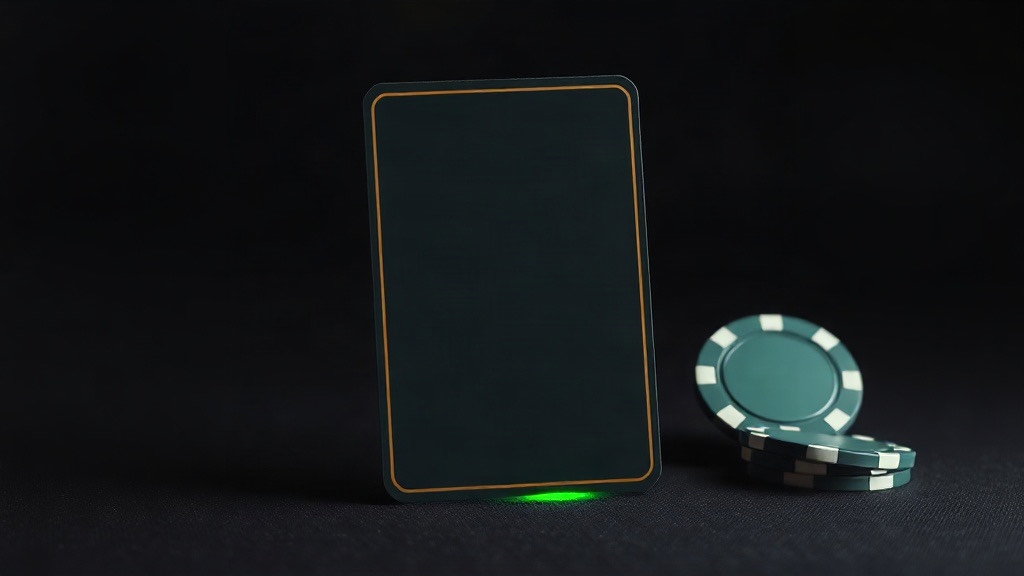
It is the most routine motion at a blackjack table and almost nobody watches it. The dealer's upcard is a ten. They slide the face-down card over a small reader built into the felt, glance at the light, and wave play on. Two seconds, no comment, and the round continues.
That two-second check is a rule, it has a name, and it is worth more to you than several rules players argue about constantly. It is called the peek, and its entire function is to decide something on your behalf before you have money in danger.
What the peek actually does
In the standard American arrangement, the dealer takes two cards at the start of every round: one face up, one face down. The face-down card is the hole card. Whenever the upcard is a ten or an ace, the only two cards that could complete a blackjack, the dealer checks the hole card before any player acts.
If it is a blackjack, the hand is over immediately. Everyone who does not also hold a blackjack loses their original bet, and nobody has had the chance to double or split. If it is not a blackjack, play proceeds and the hole card stays face down until the dealer's turn.
The important word is before. The peek resolves the worst case at the one moment when you have only a single unit at stake. That is the whole benefit, and it is invisible precisely because it works: at a peek table you simply never find yourself having doubled into a hand that was already lost.
The version without a hole card
Many tables outside the United States do it differently. Under the no hole card rule, the dealer takes exactly one card at the start of the round and does not draw a second until every player has finished acting. There is no hole card, so there is nothing to peek at.
The consequence arrives late. You are dealt an 11 against a dealer ten and you double, because that is what basic strategy says in a peek game. All the players act, the dealer draws their second card, and it is an ace. The dealer has blackjack. In the standard form of this rule you lose both units, not one, because your doubled bet was already committed when the blackjack appeared.
Same game, same hand, same decision, and a materially different outcome. The peek is the difference.
 21 TrainerPractice against a European ENHC table or eight other casino presets, with charts that redraw for the rules.
Get the app
21 TrainerPractice against a European ENHC table or eight other casino presets, with charts that redraw for the rules.
Get the app
What it costs
Per the commonly published figures, the absence of the peek costs the player roughly 0.08% through doubles and roughly 0.03% through splits, a little over a tenth of a percent in total.
That is a modest number, and it is worth being honest about the scale. It is nowhere near the roughly 1.4 percentage points that a 6:5 blackjack payout costs, and it is smaller than the cost of the dealer hitting soft 17. It sits in the same range as double after split or late surrender, which is to say: real, worth knowing, not worth panicking about.
What makes it interesting is that the cost is not evenly distributed. It falls entirely on a small number of hands, the ones where you would otherwise put out a second unit against a ten or an ace. On every other hand in the game, the peek rule is completely irrelevant.
The plays that change
Because the risk is concentrated, so is the strategy adjustment. In a no hole card game, basic strategy stops committing extra money into the upcards that can still become a blackjack.
- Doubles against a ten or an ace become plain hits. The hand you would double in a peek game is still the same hand, but the second unit now carries a risk it did not carry before, and that risk outweighs the gain.
- Splits against a ten or an ace are similarly avoided in nearly every case, for the same reason: a split doubles your exposure.
- Everything against a dealer 2 through 9 is untouched. Those upcards cannot make a blackjack, so there is nothing to protect against and the ordinary chart applies exactly.
There is one commonly noted exception in the published no-peek strategies: splitting a pair of aces against a dealer ten remains correct, because a pair of aces is a strong enough starting point to justify the exposure even with a blackjack still possible. Beyond that, the shorthand is straightforward: against a ten or an ace under no hole card, do not put out more money.
Notice how small a change that is. A player who knows the standard chart and applies this one adjustment is playing an essentially correct no hole card game. This is a good example of the general pattern in blackjack, where the hands that move with a different rule set are a short and learnable list rather than a whole second chart.
Peek, insurance and the early hand
One point of confusion is worth clearing up. In a peek game with an ace showing, the dealer will typically offer insurance before checking the hole card. It can feel as though the offer is a hint, or that the check is somehow influenced by who takes the bet.
It is neither. The hole card was dealt before anyone spoke, its value is already fixed, and the peek only reveals information the deck has already decided. Insurance is a separate side bet on that fixed card, priced with a house edge of its own, and basic strategy declines it regardless of what your main hand looks like.
The peek is also the reason the modern reader device exists. When dealers physically lifted the corner of the hole card, sharp players sometimes caught a glimpse of it, and a player who could see the hole card would hold an enormous advantage. Table readers exist to close that hole, not to speed anything up.
How to spot which game you are in
The tell is simple and takes one round to observe. Watch the deal. Two cards to the dealer, one face down, means a hole card game, and a check on tens and aces means the peek is in force. One card to the dealer, with the second drawn only after all players have acted, means no hole card.
The rule is also part of the table's posted conditions along with the payout, the soft 17 rule and the limits, so it can be confirmed before you sit. That reading habit is worth building generally, since the felt answers most of the questions that decide how you should play, as covered in our guide to reading the felt.
If you practice on an app, the setting is usually there too, and it is worth switching on deliberately rather than only ever training against the American arrangement. The adjustment is a handful of hands, but they are hands you will misplay on instinct if you have never drilled them, and instinct is exactly what takes over at a live table.
Frequently asked questions
What is the dealer peek rule in blackjack?
In a peek game the dealer takes a face-down hole card at the start of the round and checks it for blackjack whenever the upcard is a ten or an ace, usually with a small viewer built into the table. If it is a blackjack the hand ends immediately, before anyone doubles or splits. If not, play continues normally and the hole card stays face down until the end.
Why does the dealer peek matter to the player?
Because it decides whether your extra money is at risk. The peek ends the round before doubles and splits are placed, so a dealer blackjack costs you only your original bet. In a no hole card game the dealer blackjack is discovered at the end, after you have already committed those extra units, and in the standard version of that rule they are lost too.
How much does the no peek rule cost the player?
Per the commonly published figures, the no peek rule costs the player about 0.08% through doubles and about 0.03% through splits, so a little over a tenth of a percent in total. That is small next to a 6:5 payout but comparable to several rules players do notice, and it applies at every European style table where the dealer takes no hole card.
Does basic strategy change in a no hole card game?
Yes, for a handful of hands. Because a dealer ten or ace can still turn into a blackjack after you act, basic strategy stops committing extra money into those upcards: the doubles and most of the splits you would make against a ten or an ace in a peek game become plain hits. Everything against a dealer 2 through 9 is unaffected.
Do all casinos use a hole card?
No. Taking a hole card and peeking is standard in the United States, while many European and other international tables use the no hole card rule, where the dealer draws a second card only after all players have finished. The rule is part of the table's posted conditions, and it is worth confirming before you sit down since it changes several correct plays.